Scene-based Stimulation in the Context of a Visual BCI
An alternative user interface for Visual BCIs.
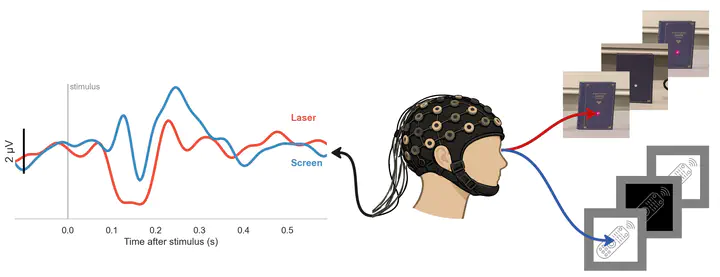 ERP comparison in the Oz electrode
Summary
Visual brain–computer interfaces (BCIs) provide a promising communication channel for individuals with severe motor impairments. One well-known example is the event-related potential (ERP) matrix speller, which enables users to select characters on a computer screen. However, such systems typically require users to repeatedly shift attention between a screen-based interface and the physical environment. In this work, we propose an in-the-scene BCI paradigm, in which users interact directly with real-world objects rather than symbolic representations on a screen. We evaluated the proposed paradigm in offline experiments in which healthy participants ($N=22$) selected target objects under two conditions; a screen-based BCI and an in-the-scene laser-based BCI. Comparisons of the elicited ERPs showed differences between the two stimulation conditions, including distinct scalp activation patterns and significantly larger N1 amplitudes in the in-the-scene condition. These findings indicate that neural responses elicited by real-world object stimulation differ from those obtained with conventional screen-based BCIs. This suggests that decoding methods may require adaptation for in-the-scene BCI systems.


Michael Tangermann
Head of the Lab, Associate Professor, PI