Closed-loop optimization of experimental parameters for brain-in-the-loop systems
Addressing individual and moment-to-moment differences through closed-loop optimization of experimental parameters
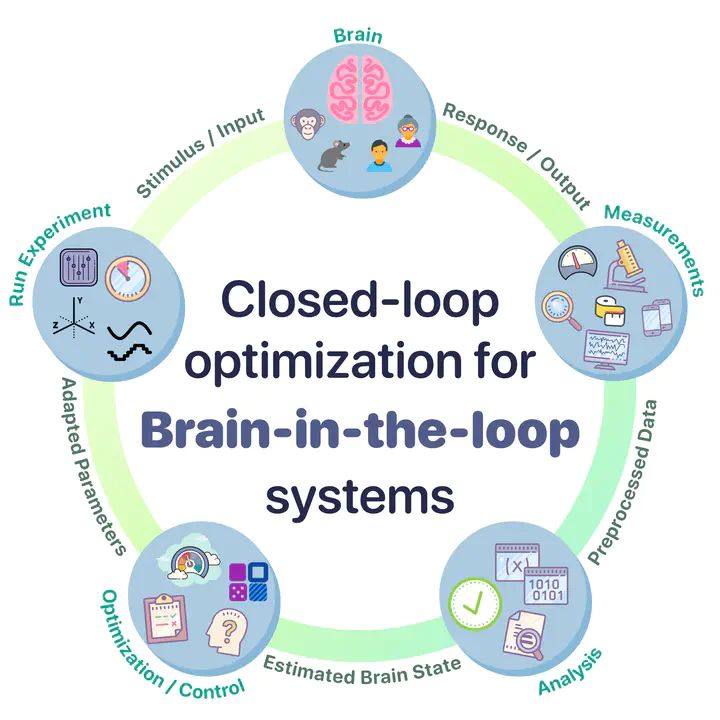 Closed-loop optimization of experimental parameters for brain-in-the-loop systems
Background
Experimental parameters can influence measured neural and behavioral signals and, consequently, the outcome of fundamental experiments or the performance of interactive, brain-in-the-loop systems. Conventional approaches typically employ a one-size-fits-all strategy, selecting parameters that perform best on average across settings (e.g., across individuals) through literature review or empirical testing. However, as the mean individual or the mean context does not exist, fixing parameters may be suboptimal, especially for cases further from the mean. Personalized and adaptable experiments and neurotechnological systems are therefore desirable. For example, for visual protocols, timing parameters (inter-stimulus interval, jitter, stimulus onset asynchrony), stimulus parameters (contrast, size, eccentricity, color) are some experimental parameters that can be personalized and adapted.
Challenges
However, optimizing brain-in-the-loop systems has specific challenges: signals and behaviors are often non-stationary; single-trial performance estimates are noisy and uncertain; sampling and evaluations are costly and constrained by limited budgets (i.e., time, cognitive resources); and experimental parameters can interact. Moreover, the objective function typically lacks a closed-form expression and is context-dependent.
Scope and Application
First, we consider brain–computer interfaces (BCIs) as an example scenario, as they are easier to investigate, and stimulation parameters are known to have an effect. However, our objective is broader: the methods and insights target personalized and adaptable experiments and neurotechnological systems with a brain in the loop in general, including human and non-human animal studies.
Approach
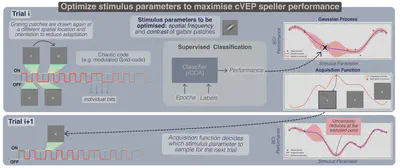
To address the challenge of optimizing uncertain, noisy, and non-stationary brain signals, we utilize Bayesian Optimization. This method is ideally suited for our context as it efficiently handles objectives that are costly to evaluate, lack a known mathematical expression (closed-form), and offer no gradient information. We initially adopt a black-box approach, utilizing this framework to achieve two distinct goals:
- Static Optimization: Finding the optimal parameter configuration specific to the individual user.
- Dynamic Optimization: Continuously adapting parameters to suit the user’s neural state at that particular moment. While currently data-driven, our roadmap involves transitioning to a model-informed approach. By incorporating physiological priors and developing “digital brain” surrogate models, we aim to guide the optimizer with domain knowledge, thereby improving convergence speed and robustness.

Sena Er
Ph.D. Student