Self-Introspection in BCI
Can users sense how well they are performing in BCI tasks?
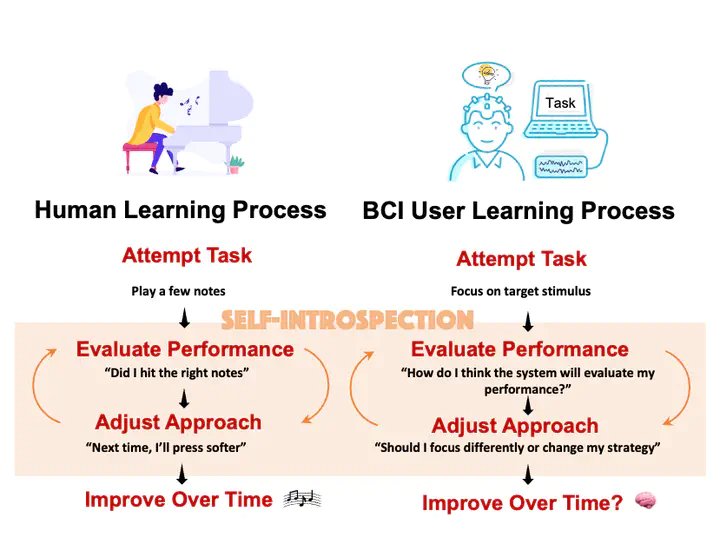
Summary
Brain–computer interfaces (BCIs) enable interaction with external systems through brain activity. Factors influencing BCI performance can broadly be divided into system-related factors, such as decoding algorithms and task design, and user-related factors, such as cognitive load, attention, and training. While system-related factors have been extensively studied, user-related factors remain comparatively underexplored.
A central open question is whether BCI users can develop an internal sense of how well they are performing during interaction. This project investigates self-introspection as a user-related capability: whether users can form an internal assessment of their own performance, whether this ability can be learned through experience, and how it relates to neural and behavioral measures in BCI tasks.
Current application and future scope
In the current phase, we study self-introspection in an auditory BCI protocol based on the experimental paradigm used in our aphasia research.
Although the present work focuses on this specific application, self-introspection is conceptualized as a general user-related capability. As such, the concept may extend to other BCI paradigms, such as motor imagery (MI), and potentially to a broader range of human–machine interaction scenarios.

Man Yang
Ph.D. Student

Jordy Thielen
Assistant Professor